February 25, 2016

A Monday Evening Visit to Uncle Vanya

Paul Rhys stars as John, our modern-day Uncle Vanya, photo courtesy of the Almeida Theatre
             Robert Icke, Associate Director at the Almeida Theatre, returns off the back of his Oresteia West End success with a reworking of Anton Chekhov’s Uncle Vanya. This production is not for the faint of heart, but rather for the seasoned theatregoer who appreciates a natural progression of events. Uncle Vanya’s aim is not to sugarcoat life, but to highlight the complexities of it – warts and all. The play spans three hours and 20 minutes, with three 10-minute intervals, so make sure you’re in it for the long haul.

             With a stream of great actors, Uncle Vanya’s cast includes: Jessica Brown Findlay (Sonya) and Tobias Menzies (Michael), both of whom you’ll know from Charlie Brooker’s Black Mirror television series, Paul Rhys (John), who is simply superb, Vanessa Kirby (Elena), Richard Lumsden (Cartwright), and Hilton McRae (Alexander) – among others.

             What I love about the Almeida is that, each time I visit, it sheds its skin to adopt a new one even more glorious than the last. Each show comes with its own unique stage assembly and I thought I was seeing things when I first set eyes on the Uncle Vanya setup. The cast is encased in a wooden frame, shaped into the bare bones of a 3D cube. Once my eyes had adjusted, I realized that the structure was in fact moving, albeit slowly. As someone on the outside looking in, as if at caged zoo animals, there is nowhere for the actors to hide. The stage places everyone in the limelight at one point or another, before it rotates to obscure some, whilst exposing others.

Elena (Vanessa Kirby) lives in a state of perpetual boredom, photo courtesy of Manuel Harlan
             The reworked play’s central plotline hints at the subtle interactions that occur amongst individuals. Alexander, a well-established professor in the city, retreats to his countryside estate with his much younger and lust-worthy second wife, Elena. Through maintaining the estate, John (the brother of Alexander’s late first wife) and Sonya (Alexander’s daughter from his first wife) keep Alexander and Elena in the lifestyle they have grown accustomed to.

             John and Michael, Alexander’s doctor, become enamored with Elena, whose exquisite beauty and vapid personality makes for a deadly combination. Meanwhile, little Sonya loves Michael from afar, hiding in the shadows while she’s outshone by her stepmother’s looks. The crux of the play arrives when Alexander suggests selling the estate for Elena’s and his own monetary gain, a declaration that unhinges John to startling proportions.

             For a Monday night, Uncle Vanya certainly provided some heavy introspective viewing, but that’s Chekhov for you. With themes of stifling boredom and a “youth is wasted on the young” undercurrent, the audience is prone to agree with Michael’s sentiment: “Life is boring.” Amongst the highs and the lows of day-to-day living, there exists a resting equilibrium, which could be described as the monotony of life. Icke’s Uncle Vanya captures that in a painstaking commentary about the cynicism of human nature.

Doctor Michael (Tobias Menzies) becomes the unassuming target of a love triangle, photo courtesy of Manuel Harlan
             The sad, hollow characters of Uncle Vanya seem to be stuck in limbo – merely surviving, rather than living. For instance, Sonya pleads with Elena, “Don’t be bored; it’s contagious.” It’s precisely that notion of boredom as contagion that floods the play. Elena manages to sap the life out of everyone around her, while not really having anything interesting to say while doing it. The soliloquys reveal a lot about the internal states of the characters. The conclusion? Perhaps it’s better not to think and not to philosophize with an intellectual mind. It can only lead to unsatisfactory ruminations, and thus, an unsatisfactory life.

             My favorite philosopher, Jean-Paul Sartre, penned “Hell is other people” in his existentialist play, No Exit, which is an absolutely enlightening read. Rather than being a physical place, Sartre suggests that hell is a metaphysical place. There’s only one word to describe being trapped in a room with vacuous, unbearable people complaining about inane, petty things, and that’s hell. Uncle Vanya perfectly embodies this idea for me. Not only are the characters tired of one another, but it’s also tiring as hell to watch them in their restless and perpetually unhappy states – ceaselessly pacing, pacing, pacing.    

John and Sonya (Jessica Brown Findlay) share a heart-to-heart, photo courtesy of Manuel Harlan
             To quote another philosopher, Albert Camus: “There is but one truly serious philosophical problem, and that is suicide. Judging whether life is or is not worth living amounts to answering the fundamental question of philosophy.” Paul Rhys as John (our modern-day Uncle Vanya) certainly grapples with this rather bleak ultimatum. He deteriorates beautifully throughout the course of the play. As he teeters on the brink of exhaustion and being fed up, he bubbles over with heart-stopping vulnerability and frailty. Just as he begins to simmer, life’s state of affairs carries on as normal without him, as if nothing ever happened. The stage continues to move at a sluggish rate, like life’s cycle, which stops for nothing and no one.

             Uncle Vanya is running at the Almeida Theatre until March 26th. Showings of the play are relatively sold out, but you might still be able to grab Day Seats or returns. Check ticket availability here.

February 16, 2016

The War of the Worlds – Alive on Stage: Martians Dominate at the Dominion

Jeff Wayne's musical version of The War of the Worlds makes its London debut, photo courtesy of Everything Theatre
             Greetings, earthlings! I feel like I’ve been on another planet with my blogging hiatus, but I’m back! The past few months have been rather hectic. My university dissertation took priority and then I graduated in December (hoorah)! The Christmas season was upon us shortly afterwards, which was swiftly followed by a flat move.

             I have a lot of exciting events coming up, especially without the constraints of university work limiting my explorations. There is the small matter of me now getting a job in the real world, but until then, London is once again my playground. I feel like I have been released into the city with new eyes of appreciation. While my student Oyster card has since expired, my passion for London has been reignited into a roaring fire that cannot be put out. 

             What better way to get back into my blogging than with a new production on the London theatre circuit – Jeff Wayne’s musical version of The War of the Worlds – Alive on Stage?

             The Dominion Theatre, which previously housed We Will Rock You, has received an extraterrestrial takeover. This is not a musical as such, nor does it aim to be. After reading H.G. Wells’ The War of the Worlds, Wayne said he “could already hear sound.” In 1978, a double album was released in the UK and 15 million copies have been sold worldwide.

             Wells’ novel was featured in Pearson’s Magazine in 1897 and elicited fear, and continues to do so, in its readers. Perhaps Martians seemed like a distant threat back in those days. With the looming progress of artificial intelligence and the insistence on creating (why, I have no idea) a sentient being, perhaps this adaptation comes at a particularly befitting time.

             The orchestra, conducted by Wayne himself, is a constant presence on the stage, which makes it unique to most shows. Rather than a story accompanied by music, The War of the Worlds is predominantly a musical spectacle. The ominous synth and rock vibes are what narrate and drive the story. 

             The star-studded cast consists of Liam Neeson as George Herbert, the journalist (by way of projector screen), Michael Praed as Herbert on stage, David Essex as the voice of Humanity, Jimmy Nail as Parson Nathaniel, Heidi Range from the band Sugababes as his wife, and Daniel Bedingfield as the Artilleryman.

             I must not forget to include the Martian Fighting Machine, which commands the audience’s attention with its fly-like eyes and skeletal metal body. It was built by Brilliant Stages, who are art directed by artist and sculptor Jacqui Pyle.

 The Martian Fighting Machine in all its gargantuan glory, photo courtesy of The War of the Worlds
             Together with the pulsating hum of “wheeoo, wheeoo,” a glowing green beacon, and a deleterious heat ray, the Martian Flying Machine is really rather intimidating. I half expected for it to take on a life of its own and clamber off the stage to zap us all to charred smithereens.

             As for the set design of The War of the Worlds, Stufish Entertainment Architects worked their magic. Automated machines, large-scale puppets, multimedia projection, and kinetic staging make this an immersive theatre experience.

             Ultimately though, in this tale of Martian domination, this version of The War of the Worlds decides to focus on the basic human instinct of survival and also of prevailing hope. As Bedingfield sings in “Brave New World” with enviable falsetto: “But maybe from the madness, something beautiful will grow, in a Brave New World, with just a handful of men, we’ll start all over again…”

             I’m reminded of Aldous Huxley’s Brave New World, which is set in 2540. In the novel, sexual promiscuity is the law and emotional attachment is illegal, which really doesn’t sound too out of place in this generation’s casual approach to relationships, or lack of them. In my opinion, we’ve most definitely surpassed George Orwell’s 1984. We are indeed “One Nation Under CCTV,” as elusive street artist Banksy illustrated.

In 2008, Banksy sent a message with this mural in central London, photo courtesy of Marcin Kruk
             In 2016, are we headed for a rise-up of machines? I’m all for having my own Baymax as seen in Big Hero 6, or even a Chappie from the movie of the same name. These are robots we can sympathize with and even come to love, but what about the invisible monsters? Ironically, bacteria end up being the downfall of the Martians in The War of the Worlds. Perhaps humankind could also be vanquished by something just as insidious. The iconic score of this stage production is frantic enough to make you seriously ponder this quandary and question your very existence.

             Book tickets for The War of the Worlds – Alive on Stage until April 2016 here.

August 12, 2015

Hola Bohemian Jewellery Tattoos

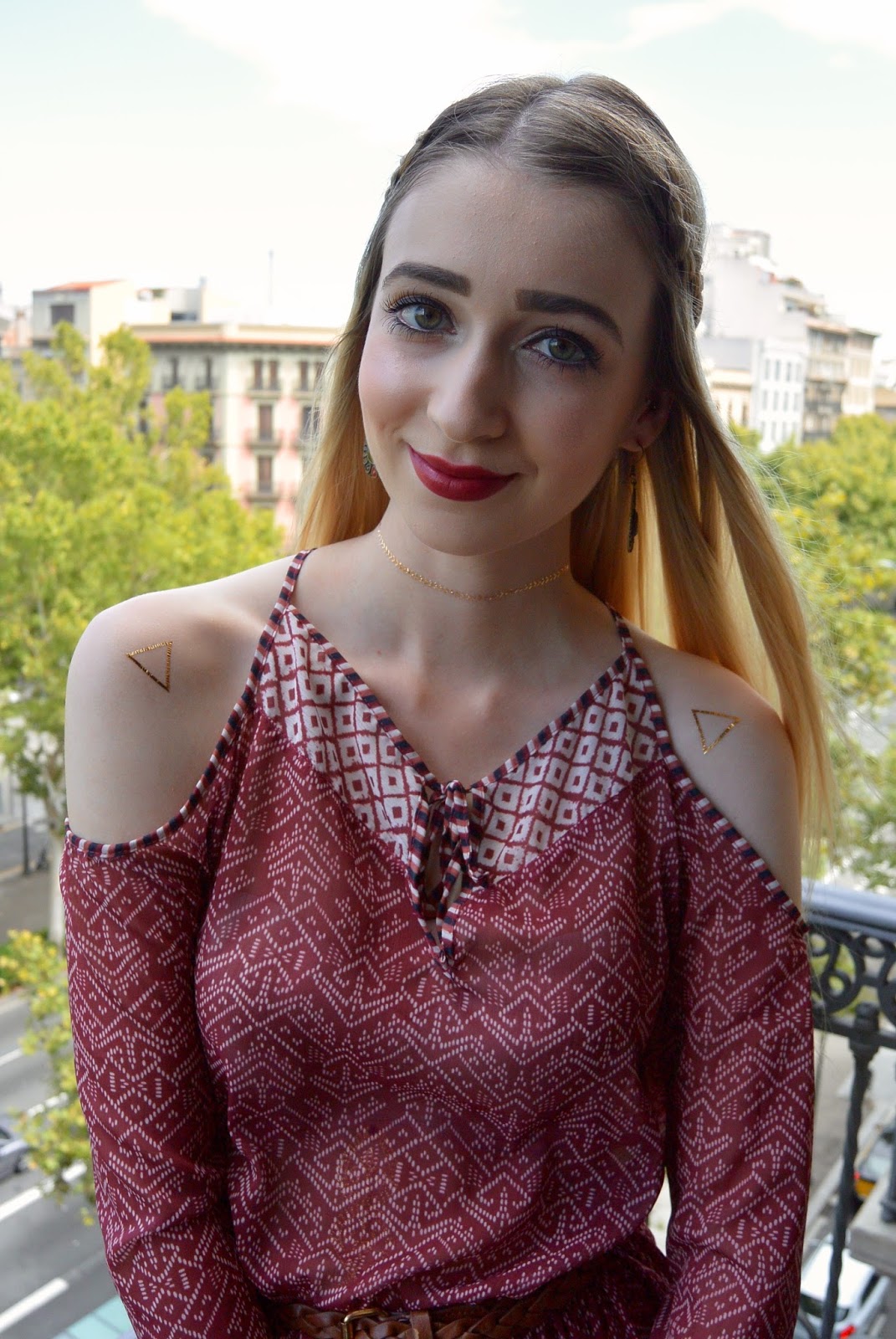
             I briefly relocated My London Dream to Barcelona to give Bohemian Jewellery Tattoos a spin! What better place to show off the British-based brand’s temporary metallic tattoos than in sunny Spain? Darel Russell and his sister Shar Alexandra first launched the brand in September 2014. I met Russell at a fashion show hosted by London Fashion Kick in April (read the post here) and have been obsessed with the products ever since.

            After I was very kindly sent over the Rihanna collection of temporary tattoos, I knew that packing accessories for Spain would be a no-brainer. There are 13 collections to select from, each containing four sheets of transfers. It’s always a worry to take precious necklaces, bracelets, and fiddly earrings on holiday, in case they are misplaced, lost, or in the worst-case scenario, stolen. Bohemian Jewellery Tattoos provides a creative and unique solution to this problem. All I had to do was pop my packet of temporary tattoos in my suitcase and I was set!

Look One: A Pool of Embellishment

             Whilst on my trip, I compiled three different looks to show how I would wear Bohemian Jewellery Tattoos. (Please note that the necklace tattoo I’m wearing above is taken from the Alexandra collection, while the rest are all from the Rihanna collection). They’re incredibly versatile, especially in terms of where they can be worn or how they can be styled, which means each individual can rock them in their own way. The application process is simple: cut out your desired tattoo, remove the plastic film, place the design on an area of your skin, hold a damp cloth on the tattoo for 30 seconds, and remove! I say 30 seconds just to be safe, but you’ll know once the design has started to lift from the paper to your newly “inked” skin.

Look Two: Gilded Florals


             Bohemian Jewellery Tattoos come in at £16.95 a collection. Sure, there are cheaper alternatives on the market, but when you scrimp on price, you’ll pay for it in quality and durability. Bohemian Jewellery Tattoos are unrivaled in both of these areas, their sparkle and texture creating the illusion of real gold or silver. As well as being waterproof and lasting up to five days, when I tested my tattoos by attempting to scrub them off, they would not budge! While this is great, if you need to remove them quickly, Bohemian Jewellery Tattoos recommends rubbing alcohol or baby oil. However, I found that Vaseline worked like a treat and is a lot less messy (and smelly). Spread Vaseline on the tattoo you would like to remove and leave it on for 10-15 minutes. The design should then disintegrate when you use a damp cloth or tissue to massage the area in circular motions.

Look Three: Blackberries & Coconut, Triangles & Love

             When I was younger, I remember that temporary tattoos were all the rage, but it appears that they are now making a comeback for grownups – stronger, bolder, and more fashionable than ever before. Replacing cartoon characters or silly symbols, Bohemian Jewellery Tattoos add sophistication and distinction to the temporary, while bordering on the realistic.

             Now it's time for you to go and experiment with your temporary tattoos! Purchase collections on the Bohemian Jewellery Tattoos website here or in various retailers throughout the UK.